Buried inside the PISA questionnaire, alongside the reading passages and mathematics problems, is a deceptively simple question: What kind of job do you expect to have when you are about 30 years old?
Fifteen-year-olds answer in their own words, and their responses are coded using ISCO-08, the International Standard Classification of Occupations. The result is a remarkable window into the imagined futures of a whole generation – and because Georgia has participated across multiple PISA cycles, we can watch how those imagined futures have shifted over an entire decade, from 2015 to 2025.
The picture that emerges is fascinating, and in places troubling. It tells us something about what Georgian teenagers value, what they think success looks like, and – reading between the lines – how little guidance they receive in forming these dreams.
The Decade in One Picture
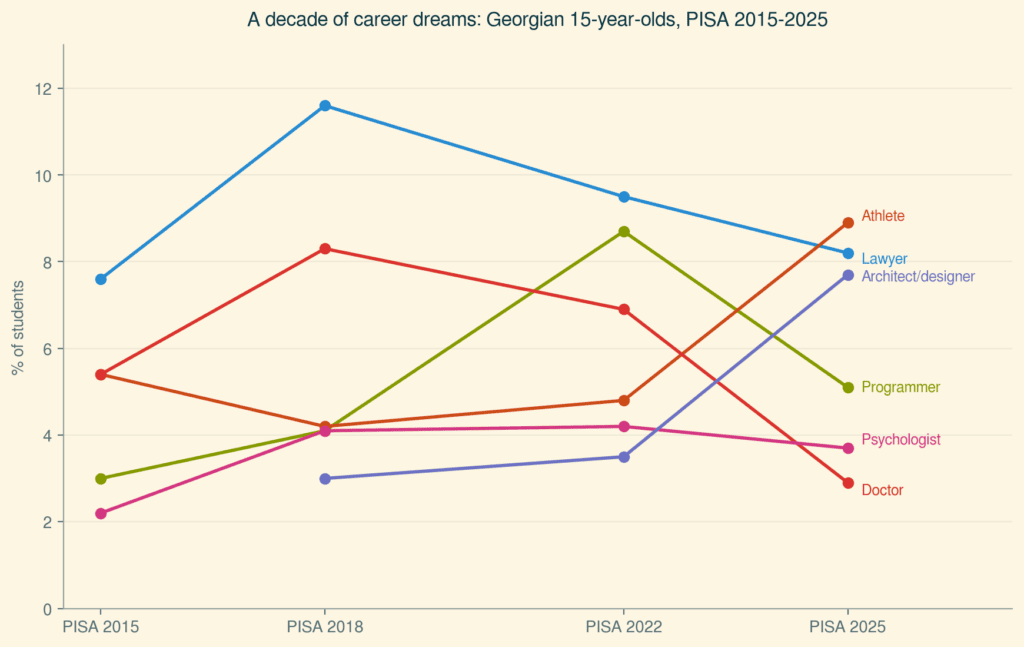
Across four PISA cycles, a handful of professions dominate the top of Georgian students’ aspirations, and the way they rise and fall tells a story.
[INSERT IMAGE: psychologe-careers-trend-2015-2025.png]
Some lines are stable, some climb, some swing dramatically. Let’s take the most important ones in turn.
Law: The Constant
If there is one enduring feature of Georgian teenagers’ aspirations, it is law. It was the single most named profession in 2015, again in 2018 at 11.6%, again in 2022 at 9.5%, and it remained near the very top in 2025 at 8.2%. For a decade, law has been either first or second on the list.
Why does law hold such a grip on the Georgian imagination? Part of the answer is its unique history and prestige in the country. But a large part is practical: a law degree is unusually versatile in the eyes of a young person. If you finish a law program, you can become a judge, work as an advocate, join any branch of law enforcement, or serve as in-house counsel in almost any company. The career paths fan out in many directions, which makes it feel like a safe, employable choice.
There is also the visible link between law and power. Many of Georgia’s politicians have historically come from legal backgrounds – the people who write the country’s laws and shape its direction. For an ambitious teenager, law looks like a path not just to a job, but to influence.
Programming: The Surge
The most dramatic climb of the decade belongs to programming. In 2015 it sat near the bottom of the top ten at 3.0%. By 2022 it had risen all the way to the most-named profession at 8.7%, and it remains prominent in 2025. (A note on the chart: in the 2025 data, “programmer” and “IT” are counted as separate categories, which is why the single programmer line dips even though technology work overall stayed strong.)
What is driving this? In my view, several forces at once. The most obvious is money: mean wages in the technology sector are high and well-publicized, and students notice. There is also social comparison – programming has become the visibly aspirational field, the thing successful people are seen to do. Add to that the simple fact that far more school students now have access to computers than a decade ago, and a genuine interest in technology among many of them.
But there is a quieter factor too: many students naming “programmer” don’t really know what programming actually involves day to day. They see the salaries and the status without seeing the work. That gap between the image of a profession and its reality is a theme we will return to.
Athletes: The Warning Sign
The most revealing pattern in the entire dataset is athletes. The share fluctuated through the decade – 5.4% in 2015, 4.2% in 2018, 4.8% in 2022 – and then jumped to 8.9% in 2025, becoming the single most-named profession.
On its face, this might look like healthy ambition. But look closer and it becomes a warning sign. Georgia has produced many successful athletes over the years – but you can count the genuinely successful ones each year on your fingers. The percentage of 15-year-olds declaring they will be professional athletes is wildly out of proportion to the actual number of people who make a living that way.
This points to two real problems. First, there is essentially no professional orientation in Georgian schools. Only around 40% of students even answer this question with a concrete profession at all; the rest simply don’t know what they want to do. Second, many of those who do name “athlete” don’t really know what they want – they haven’t confronted the extraordinary difficulty and the long odds of a sporting career. They see Kvaratskhelia. They see the fame and the money. They want the same thing, without seeing the years of work and the overwhelming probability of not making it.
An aspiration named by nearly one in ten students, for a career that a handful of people in the country actually achieve, is not really a career plan. It is the absence of one.
Psychology: The Newcomer
From 2018 onward, a new profession entered the top ten: psychology. It appeared at 4.1% in 2018, held at 4.2% in 2022, and remains a notable choice in 2025.
As someone building a psychology program, I am glad to see this. The growing popularity of psychology is a good thing for the field and for the country. But the same caveat applies here as everywhere else: do these students know what studying psychology actually involves? Psychology is not only about understanding people and helping them. It requires a great deal of statistics, along with quantitative and qualitative research methods. The gap between the popular image of the psychologist and the reality of the training is wide, and students who choose it expecting only the former are often surprised.
The Divide
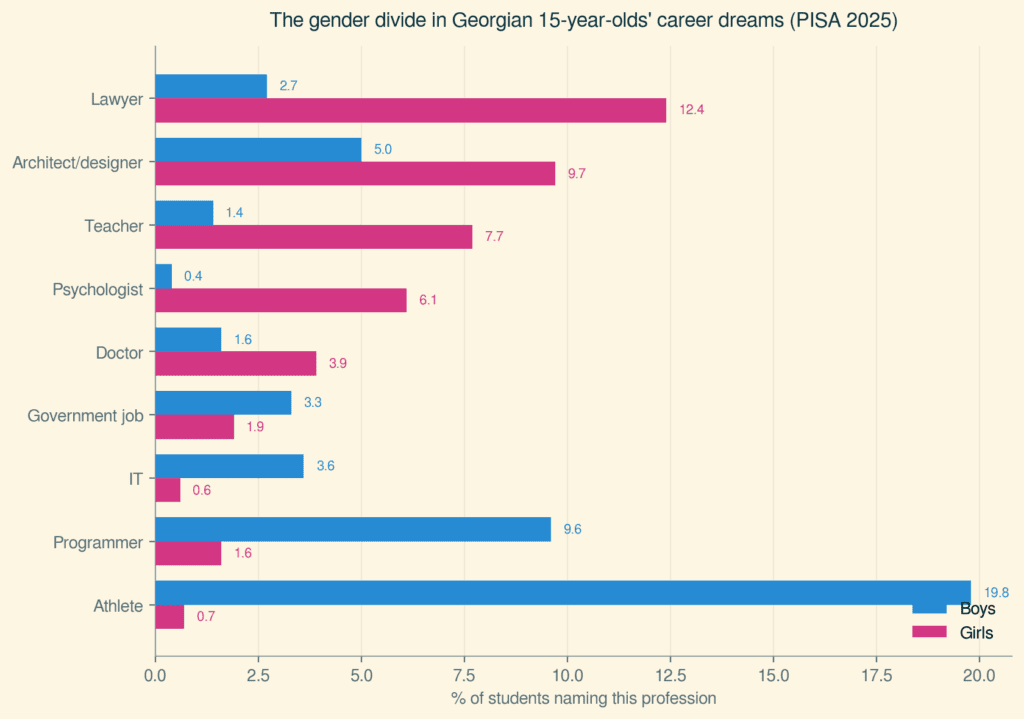
The 2025 cycle lets us break these aspirations down by sex, and the divide is stark.
[INSERT IMAGE: psychologe-careers-gender-2025.png]
The contrast barely needs commentary. Among boys, being an athlete towers over everything at 19.8%, followed by programmer at 9.6%. Among girls, law leads at 12.4%, followed by architecture or design at 9.7%, teaching at 7.7%, and psychology at 6.1%. Athletes account for 0.7% of girls; psychology accounts for 0.4% of boys.
Psychology in particular has always been far more popular among girls than boys. This is not new and not unique to these numbers – it matches my own experience. In my undergraduate cohort there were only eight boys against more than a hundred girls; at master’s level, there were just two of us among twelve women. The profession has long drawn women far more than men.
Why the divide runs the way it does across all these fields is a larger question, and one my own earlier research has touched on: gender stereotypes begin steering girls away from mathematics and science remarkably early, well before the age of 15. But whatever the deeper causes, part of the explanation returns once again to professional orientation – or its absence. Many of these students, boys and girls alike, are naming professions they don’t really understand, and the stereotyped patterns fill the vacuum that real guidance would otherwise occupy.
Dreams Are Not Plans
Step back from the individual professions and one conclusion runs through everything: Georgian teenagers are forming their images of the future in an information vacuum.
Law stays on top partly because it is one of the few careers whose paths teenagers can actually picture. Programming surges on the strength of visible salaries. Athletes spike because of a handful of famous role models. Psychology draws students who may not know what the discipline demands. And beneath all of it, only about 40% of students can name any profession at all. These are not the signs of a generation making informed choices. They are the signs of a generation guessing.
The single thing I would take from a decade of this data is that we need serious professional orientation in Georgian schools. Not a one-off talk or a leaflet, but a real, sustained effort to help students understand what different careers actually involve, what they demand, what they pay, and what the odds are. Aspirations are wonderful, and no one should discourage a teenager from dreaming. But a dream without information is not a plan – and right now, far too many Georgian students are being left to dream alone.
Data source: OECD Programme for International Student Assessment (PISA), Georgia, cycles 2015, 2018, 2022, and 2025. Professions coded using ISCO-08. Figures represent the share of 15-year-olds naming each profession as their expected occupation at age 30. The 2025 overall figures for doctor and psychologist are derived by combining the reported by-sex shares using the sex weighting implied by the published overall totals.
—
Giorgi Tchumburidze
September, 2026